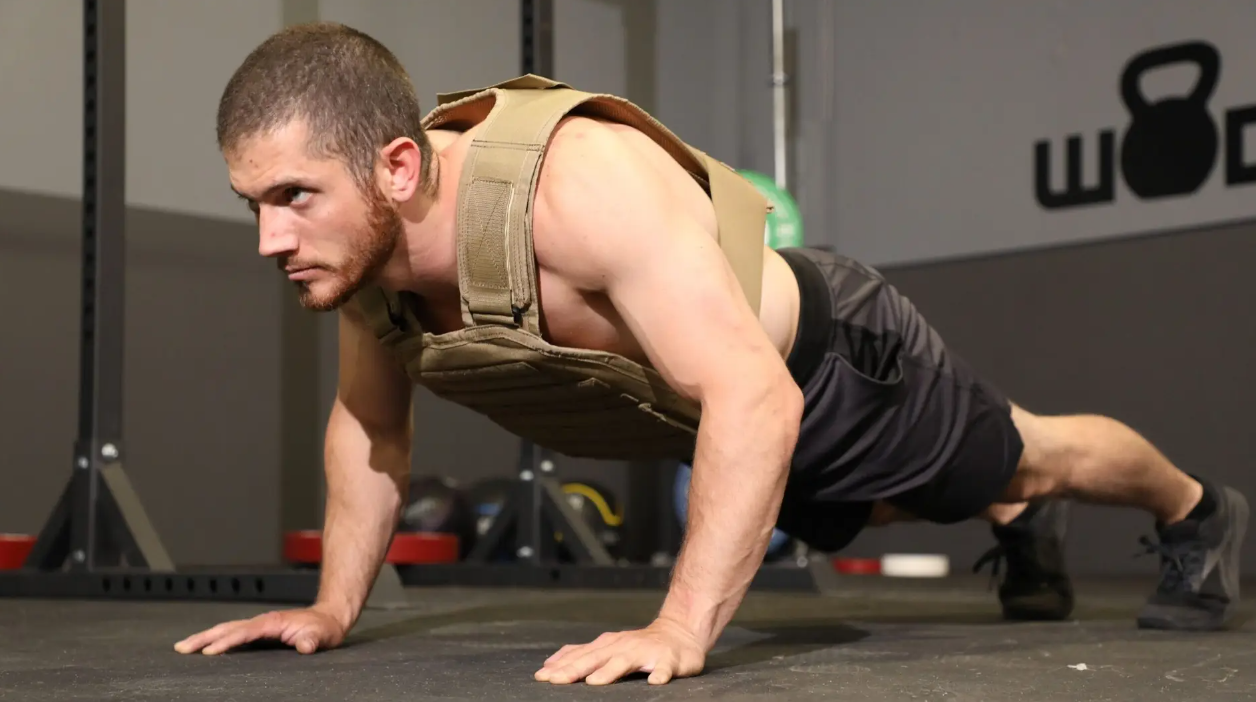
The Murph workout is one of CrossFit’s most recognizable endurance challenges. Combining running, pull-ups, push-ups, and air squats, it tests cardiovascular fitness, muscular endurance, and the ability to maintain a steady pace under fatigue. None of the exercises is particularly complicated on its own. Performing hundreds of repetitions between two one-mile runs is another matter.
A full Murph includes two miles of running and 600 bodyweight repetitions. The prescribed version adds a weighted vest, making an already demanding workout considerably harder. Success depends on more than strength or running speed. Athletes need an effective pacing strategy, consistent technique, and enough conditioning to handle the cumulative workload.
Understanding the Murph workout rules, available modifications, and common mistakes helps athletes approach the challenge with realistic expectations.
What Is the Murph Workout?
Murph is a CrossFit Hero workout named after U.S. Navy Lieutenant Michael P. Murphy, who was killed in Afghanistan on June 28, 2005, during Operation Red Wings. He was posthumously awarded the Medal of Honor for his actions during the mission.
Murphy referred to the routine as “Body Armor,” and it was reportedly one of his favorite workouts. CrossFit later named it Murph in his honor.
The challenge has become a Memorial Day tradition across the United States. CrossFit affiliates, military communities, and independent gyms organize events where participants complete the workout individually or alongside teammates.
Although Murph serves as a demanding fitness benchmark, its commemorative purpose remains central to the tradition. For many athletes, completing the workout is a way to honor Murphy and other fallen service members.
What Does the Murph Workout Include?
The traditional workout follows this sequence:
- Run 1 mile (1.6 km).
- Complete 100 pull-ups.
- Complete 200 push-ups.
- Complete 300 air squats.
- Run another mile (1.6 km).
The original CrossFit prescription calls for a 20-pound (9.1 kg) weighted vest or body armor, if available. Many modern gym events use a 20-pound standard for men and a 14-pound (6.4 kg) standard for women. Athletes who cannot safely manage the additional weight can complete the workout without it.
Murph is performed for time. The clock starts with the opening run and stops when the athlete finishes the second mile.
The real challenge is maintaining performance across different movements. Pull-ups tax the back and arms, push-ups place considerable demands on the chest and triceps, and squats gradually tire the legs before the final run.
Unlike conventional strength sessions with planned rest periods, Murph challenges athletes to manage fatigue while the clock continues running.
Murph Workout Exercises and Rules
Murph combines four familiar exercises, but completing them under fatigue requires careful attention to movement standards. Running tests cardiovascular endurance, while the bodyweight movements demand repeated muscular effort.
CrossFit standards provide a useful reference, although individual competitions may impose additional requirements. Athletes should confirm the applicable rules before attempting a scored performance.
One-Mile Run
Murph begins and ends with a one-mile run.
The opening mile should be completed at a pace that leaves enough energy for the bodyweight exercises. An aggressive start may save a little time initially but lead to much longer rest periods later.
The second mile can feel considerably harder after 300 squats. Tired quadriceps and glutes may shorten the stride, while accumulated fatigue makes maintaining a steady pace more difficult.
A measured outdoor course provides a reliable distance reference. Treadmills are another option, although organized events may specify whether they are permitted. GPS watches are useful for tracking distance but can introduce small measurement errors.
100 Pull-Ups
Pull-ups are among the most technically demanding movements in Murph, particularly for athletes with limited upper-body endurance.
A standard repetition begins with the arms fully extended and finishes when the chin passes above the horizontal plane of the bar. Cutting the range of motion short to finish repetitions faster does not meet the usual movement standard.
Strict, kipping, and butterfly pull-ups are different techniques. Strict pull-ups emphasize controlled upper-body pulling strength, while kipping and butterfly variations use coordinated hip and shoulder movement to generate momentum.
Kipping and butterfly pull-ups are common in CrossFit, but their acceptance depends on the event’s rules. They also require sufficient shoulder mobility, coordination, and technical experience.
Athletes unable to complete repeated unassisted pull-ups can substitute band-assisted pull-ups, ring rows, or another appropriate pulling movement.
200 Push-Ups
Push-ups frequently become the limiting exercise during Murph. Even athletes who can perform several strong sets may struggle as fatigue accumulates across 200 repetitions.
Under a common CrossFit push-up standard, the chest and thighs touch the floor before the athlete presses back to full elbow extension, with the body moving as a unit. Specific event requirements may differ.
Common technique problems include sagging hips, incomplete elbow extension, and shortened repetitions.
Athletes who cannot maintain standard floor push-ups can reduce the difficulty by placing their hands on a stable elevated surface.
300 Air Squats
Air squats account for half of Murph’s 600 bodyweight repetitions.
Under the standard CrossFit movement requirement, the hip crease passes below the top of the knee at the bottom of each squat. The athlete then returns to a fully upright position with the hips and knees extended.
Feet should remain planted, with the knees tracking naturally in line with the toes. A consistent stance and controlled descent help maintain balance as fatigue develops.
The challenge is not producing maximum force in any single repetition. It is completing hundreds of squats without allowing depth, posture, or movement control to deteriorate.
Partitioned vs. Unpartitioned Murph
One of the most important Murph workout rules concerns how athletes organize the 600 bodyweight repetitions.
CrossFit’s original Murph instructions allow athletes to partition the pull-ups, push-ups, and squats as needed, while keeping the opening and closing runs in their prescribed positions.
A widely used strategy is 20 rounds of:
- 5 pull-ups
- 10 push-ups
- 15 air squats
This approach preserves the required totals while alternating between muscle groups. It can help athletes maintain a consistent pace without exhausting their pushing or pulling muscles too early.
Athletes who struggle with push-ups may prefer a different arrangement:
- 5 pull-ups
- 5 push-ups
- 15 air squats
- 5 push-ups
Repeating this sequence for 20 rounds produces the same total repetitions while splitting each set of 10 push-ups into two smaller efforts.
In an unpartitioned Murph, athletes complete all 100 pull-ups before moving to 200 push-ups, followed by 300 squats and the final run.
The unpartitioned format places greater continuous demand on individual muscle groups and may require longer recovery breaks. Some competitive events specifically require this sequence, so participants should follow the organizer’s rules.
How to Prepare for the Murph Workout
Preparing for Murph involves developing aerobic fitness, muscular endurance, and the ability to transition between running and high-repetition bodyweight exercises.
Rather than repeatedly attempting the full challenge, athletes generally benefit from gradually increasing training volume and practicing smaller combinations of the prescribed movements.
Build a Running Base
Murph includes two miles of running, but the second mile comes after substantial leg fatigue.
Athletes should first become comfortable running one to two miles at a conversational pace. Once that distance feels manageable, bodyweight exercises can be introduced between shorter runs.
For example, a training session might include an easy half-mile run, several controlled rounds of push-ups and squats, and another half-mile run.
These sessions help athletes become accustomed to running with tired legs without exposing them to the full workout volume.
Develop Muscular Endurance
Murph rewards the ability to repeat moderate efforts rather than produce one maximum-repetition set.
Training should emphasize multiple submaximal sets performed with consistent technique. Someone capable of 15 clean push-ups, for instance, might practice sets of 6 to 10 repetitions with enough rest to maintain quality.
Pull-up preparation can include assisted repetitions, controlled eccentric pull-ups, and horizontal rows. These exercises develop pulling strength while allowing athletes to adjust the difficulty.
Squat volume can increase progressively through additional sets or repetitions, provided that movement quality and recovery remain adequate.
The goal is to develop enough endurance to handle repeated efforts without reaching muscular failure early in the session.
Practice Murph-Specific Workouts
Shorter versions of Murph allow athletes to test their pacing and identify weaknesses before attempting the complete challenge.
A half Murph commonly consists of:
- Run 800 meters (approximately half a mile).
- Complete 50 pull-ups.
- Complete 100 push-ups.
- Complete 150 air squats.
- Run another 800 meters.
The bodyweight movements can be divided into 10 rounds of 5 pull-ups, 10 push-ups, and 15 squats.
This format helps reveal whether running, pulling strength, or pushing endurance is the main limiting factor.
Half Murph remains a demanding session, especially for beginners. Athletes who cannot maintain controlled repetitions should reduce the volume further rather than force completion.
Prepare for the Weighted Vest
A weighted vest increases the physical demands of running, squatting, pulling, and pushing. The added load also increases mechanical stress throughout the body and can raise impact forces during running.
Athletes should establish a solid unweighted performance before introducing external weight.
Vest training can begin with a lighter load during short, controlled sessions. Distance, repetition volume, and vest weight should increase gradually rather than all at once.
A vest that fits securely and distributes weight evenly is preferable to one that shifts during movement. Poor fit can interfere with running mechanics and upper-body exercises.
Plan Recovery and Hydration
High-volume calisthenics requires sufficient recovery between demanding sessions. Sleep, regular meals, and adequate fluid intake help support training and subsequent performance.
Outdoor Murph events also require attention to weather conditions. Heat, humidity, and direct sunlight can make prolonged exercise considerably harder, particularly during Memorial Day events in warmer regions.
Athletes should avoid beginning the challenge dehydrated or immediately after another exhausting workout.
How to Complete Murph as a Beginner
A Murph workout for beginners does not need to include the full prescribed volume. Scaling allows athletes to retain the workout’s basic structure while adjusting the distance, repetition totals, or exercise difficulty.
The appropriate variation depends on current conditioning, movement proficiency, and experience with high-volume training.
Choose the Right Murph Workout Variation
| Variation | Structure | Suitable for |
| Full Murph | 1-mile run, 100 pull-ups, 200 push-ups, 300 squats, 1-mile run | Well-conditioned athletes |
| Half Murph | 800 m run, 50 pull-ups, 100 push-ups, 150 squats, 800 m run | Athletes developing endurance |
| Quarter Murph | 400 m run, 25 pull-ups, 50 push-ups, 75 squats, 400 m run | Beginners with basic movement proficiency |
| Modified Murph | Reduced volume or substituted exercises | Athletes who need additional modifications |
| Partner Murph | Partners divide the workload under agreed rules | Athletes completing a team variation |
These Murph workout variations are common training options rather than universally standardized competition categories.
In a partner Murph, both athletes may complete the runs while sharing the bodyweight repetitions. Other formats divide the running distance as well. The arrangement should be established before the workout begins.
Try Murph Without a Weighted Vest
Completing Murph without a weighted vest is one of the simplest ways to make the workout more manageable.
Removing the vest reduces external loading during the runs and bodyweight movements. It also allows athletes to concentrate on pacing and technique without additional resistance.
An unweighted Murph still includes 600 repetitions and two miles of running. Athletes unfamiliar with that workload may need to reduce the repetition totals as well.
Use Appropriate Exercise Substitutions
Exercise substitutions should address specific strength, mobility, or endurance limitations without abandoning the workout’s overall structure.
Common modifications include:
- Ring rows or band-assisted pull-ups instead of unassisted pull-ups.
- Incline push-ups instead of standard floor push-ups.
- Squats to a stable target set at an appropriate depth.
- Brisk walking or shorter runs instead of the prescribed mile distances.
For squats, a target can provide a consistent depth reference while athletes develop control and mobility. It should not encourage uncontrolled dropping onto the surface.
The chosen movements should allow participants to complete repeated sets with reliable technique and without excessive strain.
Manage the First and Final Runs
For a first Murph attempt, athletes should select a running pace they can maintain without becoming breathless before the bodyweight exercises begin.
After completing the repetitions, some participants may need to start the final mile slowly or alternate between running and walking.
A gradual return to running allows fatigued leg muscles to adjust. Maintaining control is more important than forcing a sprint when running mechanics have deteriorated.
Murph Workout Times and Performance Standards
Murph workout time depends on several variables, including running ability, muscular endurance, partitioning strategy, movement standards, and vest use.
Times recorded with a vest aren’t directly comparable to unweighted attempts. Similarly, unpartitioned results may differ substantially from times achieved using smaller rounds.
What Is a Good Murph Workout Time?
The following ranges are informal reference points for full-volume Murph attempts, not official CrossFit rankings or validated performance standards. Results are most meaningful when the workout format, movement standards, and equipment are comparable.
| Completion time | General interpretation |
| Under 35 minutes | Very fast performance |
| 35–45 minutes | Strong performance |
| 45–60 minutes | Solid recreational performance |
| 60–75 minutes | Extended but steady effort |
| Over 75 minutes | Longer-duration completion |
These categories assume the full exercise and repetition totals but do not establish a single standard for weighted and unweighted performances.
For meaningful comparisons, athletes should record whether they wore a vest, how they organized the repetitions, and which movement standards they followed.
Beginners completing scaled versions should evaluate their progress against previous attempts using the same modifications.
What Affects Murph Performance?
Several factors influence the time required to complete the workout.
Pull-up efficiency: Athletes who can sustain repeated sets without lengthy breaks spend less time recovering at the bar.
Push-up endurance: The 200 push-ups often create a major bottleneck, particularly when early sets are too large.
Running ability: Strong aerobic conditioning supports both mile runs and helps athletes recover between bodyweight movements.
Partitioning strategy: Alternating exercises can distribute muscular fatigue and make pacing more predictable.
Weighted vest: Additional resistance increases the effort required for nearly every movement.
Environmental conditions: Heat, humidity, and limited airflow can reduce sustainable exercise intensity.
The fastest athlete in any single exercise is not necessarily the fastest to complete Murph. Overall performance depends on how effectively effort is distributed across the entire workout.
How to Improve Your Murph Time
To improve your Murph time, first identify where you’re losing the most time.
Athletes who repeatedly stop during push-ups may benefit from developing greater pushing endurance. Those who complete the bodyweight portion efficiently but struggle through the final mile may need more aerobic training and practice running after squats.
Recording split times helps distinguish these limitations. Useful checkpoints include the opening mile, the completion of the bodyweight exercises, and the final mile.
Training can then target the weakest component while maintaining the conditioning required for the rest of the workout.
Common Mistakes and Safety Tips
Murph combines prolonged cardiovascular effort with an unusually high number of muscular contractions. Poor pacing, excessive training volume, and inadequate preparation can increase fatigue and injury risk.
Recognizing common mistakes helps athletes make better decisions before and during the challenge.
Starting Too Fast
Treating the opening mile as a race often leads to unnecessary fatigue during the bodyweight portion.
Athletes who begin too quickly may struggle to control their breathing during the pull-ups and need longer breaks between rounds.
The opening run should establish a sustainable effort rather than produce the fastest possible mile.
Performing Too Many Repetitions Per Set
Large early sets can cause premature muscular failure, especially during push-ups.
Once pushing strength declines substantially, even small sets may require long breaks. This can erase any time gained by completing more repetitions at the beginning.
Athletes should choose a repetition scheme they can sustain instead of repeatedly testing their maximum capacity.
Ignoring Movement Quality
Fatigue often leads to incomplete pull-ups, shortened push-ups, and shallow squats.
These repetitions may fail the applicable movement standards and can place unnecessary stress on muscles and joints when performed without control.
If technique deteriorates significantly, athletes should reduce the workload, modify the exercise, or end the session.
Adding a Weighted Vest Too Early
A weighted vest increases loading throughout the workout, particularly during running and high-repetition squats.
Athletes who have not developed sufficient conditioning may experience excessive fatigue or lose control of their movements under the added resistance.
The vest should be introduced progressively, with attention to running mechanics, joint comfort, and recovery between sessions.
Underestimating Rhabdomyolysis Risk
High-volume workouts involving unfamiliar or excessive muscular effort can contribute to exertional rhabdomyolysis, a potentially serious condition in which damaged muscle tissue releases its contents into the bloodstream.
Warning signs include severe muscle pain, unusual weakness, pronounced swelling, and dark-colored urine. Not everyone develops all of these symptoms, and normal urine color does not rule out the condition.
Ordinary post-exercise muscle soreness is common after demanding training. However, unusually severe pain, marked swelling, significant weakness, or other concerning symptoms should not be dismissed as routine soreness. Athletes experiencing these symptoms should seek prompt medical evaluation.
Familiarity with individual exercises does not guarantee readiness for Murph’s combined workload. Gradual preparation is particularly important for people who have not previously trained with high-repetition calisthenics.
Overlooking Heat and Hydration
Outdoor Murph events may involve prolonged exercise in hot conditions.
Athletes should adjust their effort to the weather, have drinking water available, and use shade or a cooler environment when necessary. Hydration is important, but drinking excessive amounts of water is not a substitute for managing heat exposure.
Dizziness, confusion, faintness, or other signs of heat illness should not be dismissed as ordinary workout discomfort. Participants should stop exercising and seek appropriate assistance when these symptoms appear.
FAQ
What is the Murph workout in CrossFit?
Murph is a CrossFit Hero workout consisting of a one-mile run, 100 pull-ups, 200 push-ups, 300 air squats, and another one-mile run. The original prescription includes a 20-pound weighted vest or body armor, if available. Many modern events use a 14-pound vest for women. The workout honors U.S. Navy Lieutenant Michael P. Murphy.
Can beginners do the Murph challenge?
Yes. Beginners can complete scaled versions using shorter runs, fewer repetitions, or modified exercises. Half Murph and quarter Murph are common options, although even these variations require sufficient conditioning. Athletes should select a workload they can complete with controlled technique.
Can you complete Murph without a vest?
Yes. Many athletes perform Murph without a weighted vest while developing fitness or preparing for a prescribed attempt. The running distances and repetition totals can remain unchanged, but the result should be recorded as an unweighted performance.
Do you have to complete 100 pull-ups before starting push-ups?
No. The traditional Murph instructions permit partitioning the bodyweight repetitions. A common approach is 20 rounds of 5 pull-ups, 10 push-ups, and 15 squats. However, some competitions require an unpartitioned format, so their specific rules take precedence.
How often should you do the Murph workout?
A full Murph is a demanding training session and does not need to be repeated frequently. Regular running, strength training, and shorter Murph-style workouts can develop the necessary conditioning. The appropriate recovery period depends on training experience, workout intensity, and individual response.