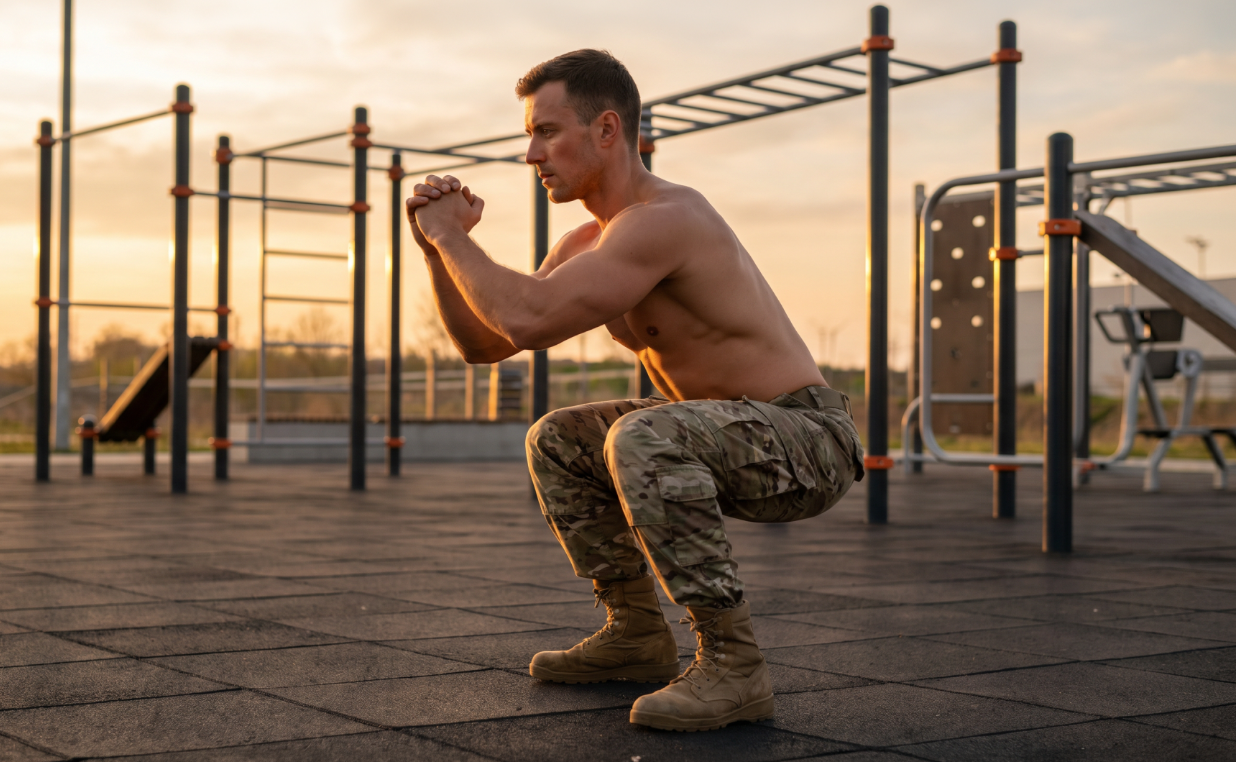
Military calisthenics uses bodyweight exercises and conditioning drills to build the strength, endurance, and physical capacity needed for demanding military tasks. Push-ups, pull-ups, squats, lunges, and core exercises form the foundation of many routines. Most require little equipment and can be performed in training facilities, barracks, or outdoor spaces.
Unlike bodybuilding programs that often organize workouts around individual muscle groups, military-style training emphasizes the ability to perform repeated physical tasks while maintaining strength, control, and coordination. Service members may need to carry equipment, climb obstacles, navigate uneven terrain, or remain physically active for extended periods. Bodyweight training develops several qualities that support these demands.
Effective military calisthenics involves more than completing high repetition counts. Exercise difficulty, proper technique, progressive overload, and adequate recovery all influence long-term results.
What Is Military Calisthenics?
Military calisthenics is a form of physical training built around bodyweight movements that develop strength, muscular endurance, mobility, and general fitness. It draws on exercises used in military physical training, although workout structures and fitness standards differ between countries and service branches.
Traditional sessions may include group warm-ups, organized exercise sequences, running, and conditioning circuits. Some programs use timed repetitions and standardized fitness assessments. Others combine calisthenics with obstacle courses, loaded carries, sprinting, and activities that reflect operational demands.
The main difference between military-oriented and recreational calisthenics lies in their objectives. Recreational athletes may pursue advanced skills such as handstands, muscle-ups, and planches. Military training generally places greater emphasis on muscular endurance, physical work capacity, and performing demanding tasks while fatigued.
Modern military fitness programs are not limited to bodyweight exercises. Resistance training, aerobic conditioning, and task-specific preparation also contribute to physical readiness.
A typical military calisthenics workout includes several movement patterns:
- Upper-body pushing through push-ups and dips.
- Upper-body pulling through pull-ups and inverted rows.
- Lower-body exercises such as squats, lunges, and step-ups.
- Core stabilization through planks and controlled abdominal exercises.
- Conditioning through running, shuttle drills, and exercise circuits.
Exercise difficulty can be adjusted through leverage, repetition ranges, movement tempo, external resistance, and rest periods.
Benefits of Military Calisthenics
One of the biggest advantages of military calisthenics is accessibility. Most exercises require only enough room to move, although pull-ups and certain other movements need a sturdy bar or suitable equipment. This allows trainees to maintain a regular workout schedule without relying on a fully equipped gym.
Muscular Strength and Endurance
Bodyweight exercises challenge muscles using the body’s own weight as resistance. Push-ups target the chest, shoulders, and triceps, while pull-ups develop the upper back and elbow flexors. Squats and lunges strengthen the legs and improve control during standing, stepping, and lowering movements.
Training results depend largely on exercise difficulty and effort. Higher-repetition sets often emphasize muscular endurance, although they can also stimulate muscle growth when performed with sufficient effort. More challenging variations that provide greater resistance can build strength when performed through controlled repetitions.
Beginners can make substantial progress with standard bodyweight exercises. As strength increases, harder variations or additional resistance may be needed to maintain a sufficient training challenge.
Cardiovascular Conditioning
Calisthenics circuits can raise heart rate when large muscle groups work continuously with limited rest. Combining squats, push-ups, step-ups, and similar exercises challenges both muscular endurance and cardiovascular fitness.
The cardiovascular effect depends on exercise intensity, session duration, and recovery intervals. A short circuit with frequent breaks places different demands on the body than a longer session performed at a steady pace.
Although circuits contribute to conditioning, they cannot fully replace dedicated aerobic training. Running and other sustained activities remain important for developing endurance over longer distances and durations.
Movement Control and Coordination
Military calisthenics involves coordinated movement across several joints. Lunges challenge balance and single-leg stability, while push-ups require the abdominal muscles and glutes to keep the torso aligned as the arms generate force.
Regular practice improves familiarity with fundamental movement patterns. It also helps trainees recognize when fatigue begins to affect posture, balance, or movement control.
These improvements support general physical preparation, although mastering bodyweight exercises does not automatically provide the skills required for every military task.
Training Flexibility
A military bodyweight workout can be adapted to different fitness levels and training environments. Beginners may start with incline push-ups, assisted pull-ups, or supported squats. Experienced trainees can increase resistance or use more demanding exercise variations.
Calisthenics does have limitations. Bodyweight exercises alone may not provide sufficient resistance for maximal lower-body strength, heavy lifting, or loaded movement. Those abilities often require additional equipment and specialized training.
Common Military Calisthenics Exercises
The most useful military calisthenics exercises cover pushing, pulling, lower-body strength, and core stability. Each movement serves a different purpose, and its difficulty should match the trainee’s strength, mobility, and experience.
Push-Ups, Pull-Ups and Dips
Push-ups
Push-ups are a staple of military physical training. They develop upper-body pushing strength and muscular endurance while requiring the core and glutes to stabilize the torso.
Start in a high plank with your hands slightly wider than shoulder-width apart. Keep your body aligned from head to heels. Bend your elbows to lower your chest toward the floor, then push back up without allowing your hips to sag or rise excessively.
Hand placement and elbow position can vary depending on individual anatomy and specific fitness-test requirements. For general workouts, use a comfortable position that allows a controlled range of motion without shoulder or wrist pain.
Beginners can perform incline push-ups against a wall, bench, or other stable surface. Advanced trainees may progress to weighted push-ups, deficit push-ups, or mechanically harder variations.
Pull-ups
Pull-ups primarily target the latissimus dorsi, upper-back muscles, and elbow flexors. They also develop grip strength and body control.
Hang from a secure bar using a comfortable grip. Pull yourself upward until your chin clears the bar, then lower your body under control. Avoid excessive swinging or relying on momentum to complete repetitions.
If a full pull-up is too difficult, begin with assisted pull-ups, controlled negatives, or inverted rows. These alternatives help build the strength needed for a full pull-up.
Dips
Dips train the triceps, chest, and front shoulder muscles. They are typically performed on parallel bars or another stable support designed for the exercise.
Begin with your arms supporting your body. Bend your elbows and lower yourself only as far as your shoulder mobility and control allow. Press back up without bouncing at the bottom.
Dips place considerable stress on the shoulders and are not suitable for everyone. Close-grip push-ups provide an alternative for trainees who experience discomfort.
Squats, Lunges and Core Exercises
Bodyweight squats
Squats strengthen the quadriceps and glutes while developing control through the hips, knees, and ankles.
Stand with your feet approximately shoulder-width apart, adjusting your stance as needed. Bend your hips and knees to lower your body while keeping your feet planted. Descend as far as you can comfortably control, then return to standing.
Squat depth should reflect individual mobility and strength rather than an identical target for every trainee.
Lunges
Lunges work the quadriceps, glutes, and muscles responsible for maintaining balance. Because each leg works independently, they also challenge single-leg control.
Step forward or backward into a split stance. Bend both knees to lower your body, keeping your front knee aligned with your foot. Push through the working leg to return to the starting position.
Reverse lunges are often easier for beginners to control than walking lunges. More advanced options include weighted lunges and rear-foot-elevated split squats.
Planks
Planks strengthen the abdominal muscles and train the trunk to resist excessive arching of the lower back. They also require the shoulders and glutes to help maintain a stable position.
Rest on your forearms and toes, keeping your body relatively straight from head to heels. Breathe normally and maintain abdominal tension without allowing your hips to drop.
Short holds with proper form are more useful than longer holds with a sagging back or raised hips.
Additional core movements
Dead bugs, side planks, bird dogs, and reverse crunches challenge core stability and control in different ways.
A balanced core routine should include exercises that resist unwanted movement as well as exercises that move the trunk or pelvis through a controlled range of motion. This provides more varied training than relying entirely on high-repetition sit-ups.
Military Calisthenics Workout Routine
This military workout combines strength, muscular endurance, and conditioning across three nonconsecutive days. It is suitable for generally healthy beginners and intermediate trainees who can adjust exercise difficulty to their abilities.
The program is inspired by military training but is not an official fitness test or preparation plan for a particular service branch.
Walking, easy running, or other low-intensity aerobic activity can be included between workouts according to fitness and recovery needs.
The repetition ranges are flexible targets rather than mandatory minimums. Beginners who cannot complete the lower end of a range with proper form should use an easier variation or reduce repetitions until their strength improves.
Day 1: Upper-Body Strength and Core
| Exercise | Sets | Repetitions |
| Push-ups | 3 | 8–15 |
| Pull-ups or assisted pull-ups | 3 | 4–8 |
| Incline or close-grip push-ups | 2 | 8–12 |
| Inverted rows | 2 | 8–12 |
| Forearm plank | 3 | 20–40 seconds |
| Side plank | 2 | 20–30 seconds per side |
Rest approximately 60–120 seconds between sets. More demanding strength exercises, particularly pull-ups and challenging push-up variations, may require two to three minutes or longer to maintain performance. Beginners can omit one secondary pushing or pulling exercise until they can comfortably manage the full workload.
Choose variations that allow you to finish most sets with roughly two or three controlled repetitions remaining before muscular failure.
Day 2: Lower-Body Training and Conditioning
| Exercise | Sets | Repetitions |
| Bodyweight squats | 3 | 12–20 |
| Reverse lunges | 3 | 8–12 per leg |
| Step-ups | 3 | 8–12 per leg |
| Glute bridges | 3 | 12–15 |
| Dead bugs | 3 | 8–10 per side |
Rest for approximately 60–120 seconds between sets. If standard squats and lunges become too easy, use more challenging variations or add resistance rather than continually increasing repetitions.
After the strength exercises, complete 10–20 minutes of easy-to-moderate aerobic activity. Brisk walking, jogging, or cycling are suitable options.
Beginners should prioritize a sustainable pace. More experienced trainees can gradually extend the aerobic portion or complete conditioning in a separate session.
Day 3: Full-Body Muscular Endurance
Complete the following circuit for two to four rounds.
| Exercise | Repetitions |
| Push-ups | 8–12 |
| Bodyweight squats | 15–20 |
| Inverted rows or assisted pull-ups | 6–10 |
| Alternating reverse lunges | 10 per leg |
| Mountain climbers | 20 total |
| Forearm plank | 30 seconds |
Move between exercises with enough rest to maintain proper form. After each round, recover for approximately 60–120 seconds, extending the break if necessary.
Beginners can start with two rounds. Intermediate trainees may complete three or four rounds, provided they can maintain consistent technique without reaching muscular failure on every exercise.
Warm-Up and Recovery
Begin each workout with five to ten minutes of gradually increasing activity. Brisk walking, easy jogging, arm circles, and controlled bodyweight squats can prepare the muscles and joints for more demanding movements.
Include exercises that resemble the upcoming workout. Before pull-ups, for example, light hanging or easier rowing movements can help prepare the shoulders and upper back.
After training, use a few minutes of easy movement to let your breathing and heart rate settle. Stretching is optional and should not be treated as a reliable way to prevent post-exercise soreness.
Adequate sleep, sufficient nutrition, and appropriate training volume have a greater influence on recovery than any particular cooldown routine.
How to Progress in Military Calisthenics
Progressive overload keeps bodyweight training effective as fitness improves. Repeating the same easy workout indefinitely may maintain existing abilities, but further gains require a stronger training stimulus.
Several methods allow trainees to increase difficulty without sacrificing exercise technique.
Increase Repetitions Before Difficulty
Start with a variation that allows you to complete the prescribed repetition range with proper form.
For example, if your target is 8–12 push-ups, choose a version you can perform for at least eight controlled repetitions without reaching failure.
Once you can complete every set at the upper end of the range, move to a harder variation. A beginner might progress from incline push-ups to standard push-ups, then eventually introduce weighted or more mechanically demanding versions.
Adjust Exercise Leverage
Changing body position can increase resistance without adding large numbers of repetitions.
Pull-ups can progress from assisted repetitions to unassisted sets and eventually weighted pull-ups. Lower-body training may advance from standard squats to split squats or other single-leg exercises.
More advanced movements are useful only when the trainee has enough strength, mobility, and coordination to perform them correctly.
Manage Rest Periods
Rest intervals influence the type of training challenge.
Longer breaks generally help preserve performance during demanding strength exercises. Shorter breaks increase the conditioning demands of a workout but may reduce the number of quality repetitions completed.
Adjust recovery periods according to whether the session emphasizes strength, muscular endurance, or conditioning.
Track Performance
A basic training log can record exercises, sets, repetitions, variations, and perceived effort.
For example, increasing from three sets of eight push-ups to three sets of twelve with the same technique and exercise variation demonstrates improved performance. Once those repetitions become manageable, additional resistance may provide a better challenge than simply adding more volume.
Compare performance over several weeks rather than judging progress from a single session.
Balance Strength and Conditioning
Military physical readiness involves several physical qualities that cannot always be developed equally within one workout.
Running, loaded carries, and other task-specific activities may need dedicated sessions. Frequent high-intensity conditioning combined with large volumes of bodyweight exercises can make recovery difficult.
Increase training demands gradually rather than adding more repetitions, harder variations, and extra conditioning simultaneously.
Common Mistakes and Injury Prevention
Military-style training often involves working through physical fatigue. However, pushing beyond the point where technique deteriorates can increase unnecessary stress without improving the workout.
Prioritizing repetition counts over technique. Rushing through exercises can reduce movement control and shorten the effective range of motion. Use consistent technique and end sets when form begins to break down.
Training to failure too frequently. Maximum-effort sets are not necessary throughout every workout. Stopping with a small number of repetitions remaining can provide an effective training stimulus while limiting excessive fatigue.
Neglecting pulling exercises. Push-ups are convenient, but relying on them almost exclusively leaves the upper-back muscles undertrained. Include rows or pull-ups to develop a more balanced upper body.
Increasing workload too quickly. Sudden increases in push-up volume, running distance, or high-impact conditioning can exceed current physical capacity. Increase workload in manageable stages, particularly after extended inactivity.
Ignoring lower-body resistance needs. Standard bodyweight squats may eventually become too easy to challenge experienced trainees. Single-leg variations or added resistance can address this limitation.
Using unsuitable equipment. Pull-up bars, dip stations, benches, and elevated surfaces must be stable and capable of supporting the intended load. Avoid improvised setups that could slip, collapse, or move unexpectedly.
Overlooking signs of excessive fatigue or injury. Persistent soreness, declining performance, unusual fatigue, and disrupted sleep may warrant additional recovery or a reduction in training load. Sharp pain, swelling, or symptoms that worsen during exercise should not be ignored.
FAQ
Is military calisthenics good for beginners?
Yes. Many exercises can be adapted to different fitness levels. Incline push-ups, assisted pull-ups, supported squats, and shorter plank holds allow beginners to develop strength and coordination before attempting harder movements. Start with manageable training volume and increase it as performance improves.
Can military calisthenics build muscle?
Yes. Bodyweight exercises can stimulate muscle growth when they provide sufficient resistance and training volume. Beginners may build muscle with standard push-ups, pull-ups, and squats. Experienced trainees generally need more challenging variations or external resistance. Nutrition and recovery also affect results.
How often should you do military calisthenics?
Three training sessions per week on nonconsecutive days are a practical starting point for many beginners. The sessions can emphasize different muscle groups or training goals, as in the routine above. Experienced trainees may train more frequently when total workload and recovery are managed appropriately.
Is military calisthenics better than weightlifting?
Neither approach is universally superior. Calisthenics is convenient for developing bodyweight strength, muscular endurance, and movement control. Weightlifting allows more precise resistance adjustments and is particularly useful for building maximal strength. Combining both methods can provide broader physical preparation.
Can military calisthenics replace running?
Calisthenics circuits can improve cardiovascular conditioning, but they do not fully reproduce the adaptations developed through regular running. Anyone preparing for a timed run, distance requirement, or sustained running activity should include running-specific training.